 My Bookshelf
- Home
- The Practice and Policy of Environmental Law
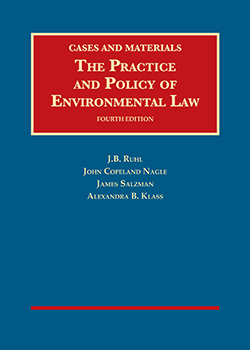
The Practice and Policy of Environmental Law


This title is a part of our CasebookPlus™ offering as ISBN 9781642428735. Learn more at
Faculty-CasebookPlus.com.
The Practice and Policy of Environmental Law, 4th is the only environmental law book on the market that includes a significant focus on the practice of environmental law. Part I of the book covers all the major environmental law regulatory programs: Endangered Species Act, Clean Water Act, Clean Air Act, CERCLA, RCRA, NEPA, Public Lands, and Climate Change. Part II then takes that foundation and uses cases, materials, and problem exercises to immerse the student in the key practice realms of environmental law: rulemaking and permitting, compliance counseling, enforcement, private litigation, and business transactions.
Imprint: Foundation Press
Series: University Casebook Series
Publication Date: 12/02/2016
J. B. Ruhl, Vanderbilt University Law School
John Copeland Nagle, Notre Dame Law School
James E. Salzman, University of California-L.A. School of Law
Alexandra Klass, University of Michigan Law School
CasebookPlus™
This title is available in our CasebookPlus format. CasebookPlus provides support beyond your classroom lectures and materials by offering additional digital resources to you and your students. Anchored by faculty-authored formative self-assessments keyed to our most popular casebooks, CasebookPlus allows students to test their understanding of core concepts as they are learning them in class – on their own, outside of the classroom, with no extra work on your part. CasebookPlus combines three important elements:
- A new print or digital casebook
- Access to a downloadable eBook with the ability to highlight and add notes
- 12-month access to a digital Learning Library complete with:
- Chapter questions keyed to the casebook
- Black Letter Law questions (available in select subjects)
- Subject area review questions for end of semester use
Leading digital study aids, an outline starter, and audio lectures in select subjects
Students can still utilize CasebookPlus digital resources if they’ve purchased a used book or are renting their text by purchasing the Learning Library at westacademic.com.
With CasebookPlus, you can customize your students’ learning experience and monitor their performance. The quiz editor allows you to create your own custom quiz set, suppress specific quiz questions or quiz sets, and time-release quiz questions. Additionally, the flexible, customized reporting capability helps you evaluate your students’ understanding of the material and can also help your school demonstrate compliance with the new ABA Assessment and Learning Outcomes standards.
Changes throughout this edition include:
Chapter 2 (endangered species): The authors added Markle Interests v. United States Fish & Wildlife Service, 2016 U.S. App. LEXIS 12066 (5th Cir. 2016), explaining how the Endangered Species Act’s critical habitat provisions apply on private land.
Chapter 3 (air): This edition adds a discussion of Michigan v. EPA, 135 S. Ct. 2699 (2015), a discussion of new ozone NAAQS in 2015, the authors deleted problem exercise involving lead NAAQs, a primary case of EPA v. Homer City Generation, 134 S. Ct. 1584 (2014), a discussion of Cross-State Air Pollution Rule, a discussion of 2015 New Source Performance Standard for GHG emissions from new fossil-fuel powered electric generating plants, a discussion of EPA's Clean Power Plant for existing electric generating plants, a main case of Utility Air Regulation Group v. EPA, 134 S. Ct. 2427 (2014),as well as the deletion a main case of Environmental Defense v. Duke Energy, 549 U.S. 561 (2007) in favor of a note.
Chapter 4 (water): The authors added substantial updates on state regulation of groundwater resources and information on the Chesapeake Bay TMDL; a new section on the Safe Drinking Water Act and the Flint, Michigan drinking water crisis; a discussion of the Waters of the United States rule governing wetlands; extensive new coverage in the public trust section of Robinson Township v. Commonwealth of Pennsylvania, 623 Pa. 564 (Pa. 2013) and update of the atmospheric trust litigation initiative.
Chapter 5 (waste): This edition adds updates to the definition of solid waste rule under RCRA, EPA's "e-manifest" system for hazardous waste; a discussion of Second Circuit "Act of War" defense to CERCLA in 9/11 case; extensive note discussion of CTS Corp v. Waldburger, 134 S. Ct. 2175 (2014) and CERCLA statutes of limitation.
Chapter 8 (climate change): This edition includes an excerpt of the Paris Agreement negotiated in furtherance of the United Nations Framework Convention on Climate Change in December, 2015; two new cases illustrating the tension between renewable energy projects and environmental protections for public lands: Oregon Natural Desert Association v. Jewell, 2016 U.S. App. LEXIS 9642 (9th Cir. 2016), and Protect Our Communities Foundation v. Jewell, 2016 U.S. App. LEXIS 10269 (9th Cir. 2016).
Chapter 9 (rulemaking and permitting): The authors added a note on mitigation with analysis of the 2015 Presidential Memorandum.
Learn more about this series.
Access Denied
Law School Faculty - Sign in or Create an Account to access this content. Law faculty who have created an account can sign in after receiving email notification that registration has been approved. Email accountmanager@westacademic.com or call 800-313-9378 for assistance.
Other Higher Education Faculty who wish to access digital review copies or teaching resources should contact their West Academic Account Manager at college@westacademic.com or 800-360-9378.
Adopters Only
This content is intended for adopters only. Sign in or Create an Account to access this content. Law faculty who have created an account can sign in after receiving email notification that registration has been approved. If you are an adopter who is unable to access this content after signing in, contact your account manager for assistance at accountmanager@westacademic.com or call 800-313-9378 for assistance.
Access Denied
Sign in or Create an Account to access this content. Faculty who have created an account can sign in after receiving email notification that registration has been approved. Contact us for assistance.
Law School Faculty: email accountmanager@westacademic.com or call 800-313-9378.
Other Higher Education Faculty: email college@westacademic.com or 800-360-9378.
Access Denied
Higher education faculty who wish to view this document should contact their West Academic Account Manager at college@westacademic.com or 800-360-9378.